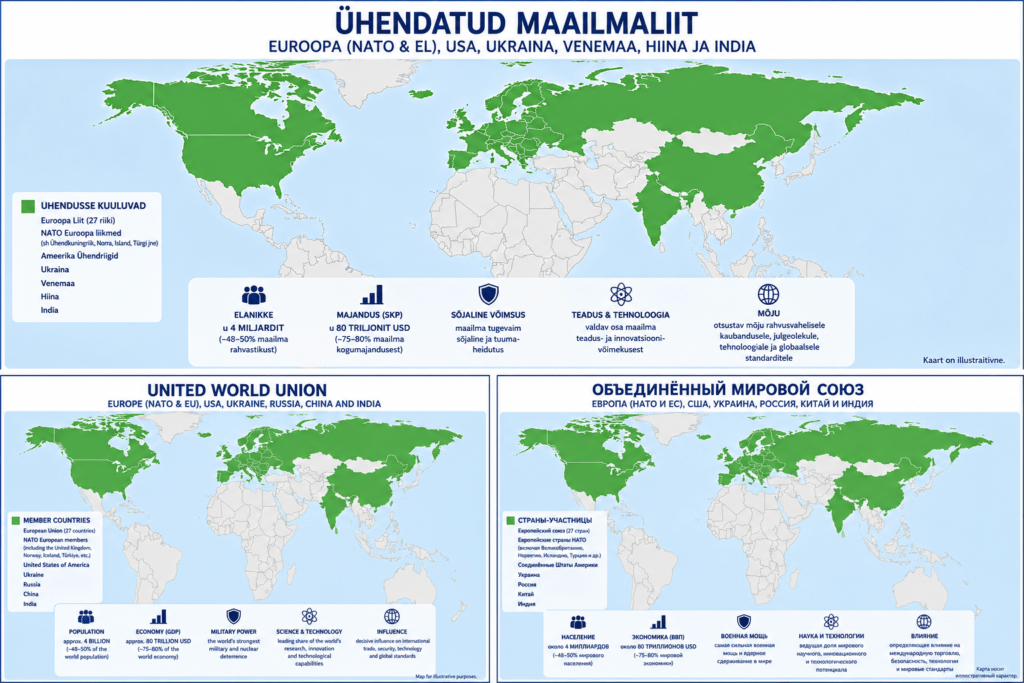

The subject of this piece is “Thought Experiment: A Global Alliance.” I thought for a very long time before deciding to publish it.
The point is to explore, to some extent, what effect an alliance of all the world’s major powers might have. At first glance, the question seems almost too trivial. And indeed, the conversation with ChatGPT below shows that the potential and influence of such an alliance could be simply unprecedented and could shape the course of humanity.
And from this, my own thoughts emerge. I dare to imagine a scenario in which the participants in such an alliance choose to act responsibly and place the common interests of humankind above their narrow-minded egoism.
This would make it possible to firmly uphold the international legal order, establish peace, protect human rights, coordinate joint solutions to global problems, and undertake global projects (for example, the colonization of space).
It would be an enormous positive turning point.
But the interview below also shows what stands in the way of such a turning point—the contradictions among the participants. The war in Ukraine deserves particular emphasis, as it is seriously poisoning the West’s relations with Russia today and will continue to do so far into the future.
Thus, the question is ultimately about nothing other than our way of thinking. If the great powers could understand that there is something far more important than their hysterical national egoism, a great deal would change. It is not said in vain that from everyone who has been given much, much will be demanded. If you are great and powerful, your responsibility is correspondingly great. And so it turns out that the most important and greatest resource is the spirit. In this sense, the fate of humanity truly lies in our own hands. If we do not survive, it will be our own fault.
I know that it is very difficult to believe in comprehensive, committed, and friendly cooperation among the world’s great powers. The last time one could really speak of such cooperation was during the Second World War, when the United Nations coalition stood against Nazi Germany. The work of the UN Security Council shows just how difficult such cooperation is. It is precisely among its permanent members that the greatest quarrelling takes place. Why are they unable to achieve the cooperation described above? That is the question.
Do we believe that the great powers of this world can find within themselves the will to cooperate and a sense of responsibility toward themselves and all the people of the world?
Interview with ChatGPT
Question
What would be the economic, military, and scientific potential and influence of an alliance comprising Europe (EU and NATO members), the United States, Ukraine, Russia, China, and India?
Answer
This is an interesting thought experiment because the alliance described would encompass almost all of the world’s greatest economic, scientific, and military capabilities. If we assume that it were a genuinely functioning alliance—not merely a formal organization—its influence would be unprecedented.
Population
If we add together:
- European Union: ~450 million
- Other European NATO members (UK, Norway, Turkey, Iceland, etc.): ~160 million
- United States: ~345 million
- Ukraine: ~32 million
- Russia: ~143 million
- China: ~1.41 billion
- India: ~1.45 billion
Total: about 4 billion people, or approximately 48–50% of the world’s population.
Economic Power
By nominal GDP (approximate figures):
- United States – ~$31 trillion
- EU – ~$20 trillion
- UK – ~$4 trillion
- India – ~$4.5 trillion
- China – ~$19 trillion
- Russia – ~$2 trillion
- Ukraine – ~$0.2 trillion
Total: approximately 80 trillion US dollars per year.
This would amount to roughly 75–80% of the global economy.
Even more importantly, the alliance would include:
- the world’s largest financial centers;
- most high-tech manufacturing;
- leading agricultural regions;
- the largest energy reserves;
- most of the processing capacity for rare metals;
- the world’s most important trade routes.
Military Power
It would essentially be the strongest military force in the world.
Nuclear Weapons
The alliance would include the three largest nuclear powers:
- United States
- Russia
- China
and, in addition:
- United Kingdom
- France
- India
Together, they would possess practically the world’s greatest nuclear deterrent.
Conventional Forces
- the largest air force
- the largest navy
- the world’s most advanced satellite systems
- the most advanced intelligence network
- the most powerful cyber defense
- enormous industrial arms-production capacity
There would be no comparable adversary anywhere in the world.
Science and Technology
Almost the entire scientific elite of the world would be concentrated here.
For example:
- Silicon Valley
- European research centers
- Chinese technology cities
- India’s IT sector
- the world’s leading universities
- a large share of Nobel Prize laureates
- most space programs
Such an alliance would control a large share of:
- artificial intelligence development;
- semiconductor technology;
- biotechnology;
- drug development;
- quantum computing;
- space research.
Energy Capacity
The alliance would simultaneously possess:
- energy resources independent of the Middle East;
- Russia’s gas and oil;
- US shale gas;
- Canadian and Norwegian resources (through NATO);
- China’s renewable-energy production;
- India’s rapidly growing energy market;
- Europe’s experience in nuclear and renewable energy.
Influence on World Politics
Its authority would depend on whether the alliance could act as one.
If it could, it might:
- set global technological standards;
- shape the rules of international trade;
- influence currency markets;
- lead climate policy;
- coordinate responses to pandemics;
- guide space exploration;
- resolve a large share of international conflicts.
The decisions of such an alliance would affect almost every country in the world.
Internal Challenges
At the same time, the greatest difficulty would lie precisely in making such an alliance function.
Its participants would include very different political systems and interests:
- liberal democracies;
- authoritarian states;
- different security priorities;
- competing economic interests;
- historical tensions.
For example, serious tensions today exist between:
- NATO and Russia;
- the United States and China;
- India and China.
Overcoming such disagreements would require unprecedented trust and institutions.
If the Alliance Nevertheless Worked…
If we imagine that all these countries were able to cooperate over the long term in pursuit of common goals, the result would be an organization with:
- about 4 billion inhabitants;
- an economy of nearly 80 trillion US dollars;
- the world’s strongest military power and nuclear deterrent;
- a dominant share of the world’s scientific and innovation capacity;
- decisive influence over international trade, technology, and security.
Such an alliance would probably become the most influential international organization in history. Its authority would rest not only on military or economic superiority, but also on its ability to shape global norms and standards and develop shared solutions to problems that no country can solve alone. At the same time, its success would require exceptionally effective governance and a willingness among its members to place common interests, at least in some areas, above their narrow geopolitical objectives.
The Impact of the Russia–Ukraine Conflict
This is the most difficult question in this thought experiment. If Russia and Ukraine were members of the same alliance, everything would depend on the conditions under which they had arrived there.
At least three scenarios can be imagined.
1. The Conflict Is Resolved Before the Alliance Is Created
This would be the most realistic foundation for a functioning alliance. It would mean that:
- hostilities have ended;
- the parties have reached a peace agreement (however difficult the compromise required to achieve it might be);
- international security guarantees are in place;
- border issues and the handling of war damages have been at least partly resolved.
In such a case, mistrust would persist for decades, but institutions would help contain it. European history offers a similar development: France and Germany, for example, were rivals for centuries, but after the Second World War they became pillars of European integration.
2. The Conflict Continues, but Both Belong to the Alliance
This would be a highly unstable situation. The alliance would have to deal continuously with an internal crisis:
- peacekeeping missions;
- arbitration tribunals;
- joint security forces;
- the use of sanctions or vetoes.
Such an organization would find it difficult to act in unity on other issues as well, because the conflict would affect relations among its members.
3. A Higher Common Goal Outweighs the Confrontation
History shows that greater challenges can sometimes compel former adversaries to cooperate. If, for example, humanity were confronted by a global threat (a worldwide catastrophe, a cosmic threat, an extremely severe climate crisis, or some other existential problem), states might come to see greater value in cooperation than in confrontation.
This would not erase the past, but it would change priorities.
What Effect Would This Have on the Alliance?
During the first years, the Russia–Ukraine issue would probably be the organization’s most sensitive subject. It would require:
- strong legal institutions;
- independent courts;
- shared security mechanisms;
- confidence-building programs;
- extensive economic cooperation.
If these worked, something similar to what happened in Western Europe after 1945 might gradually emerge: former enemies did not necessarily become friends, but they learned to resolve their disagreements by political and legal means rather than by force of arms.
Paradox
Interestingly, the very fact that Russia and Ukraine belonged to the same strong alliance could become one of the preconditions for long-term peace. If both were bound together by common institutions, economic ties, and security arrangements, the cost of armed conflict would become so high that avoiding it would be in everyone’s interest.
At the same time, the impact of historical trauma must not be underestimated. The loss of life caused by the war, shattered trust, and mutual accusations will not disappear through a single treaty or the creation of an organization. The success of such an alliance would therefore depend less on its economic or military power and more on whether it could establish a just and trustworthy order in which both Russia and Ukraine saw their security and dignity protected. This would be a long-term process, measured in decades rather than years.